Podcast Recording Studio Bali — 2026 Audio Quality & Prices Guide
TL;DR
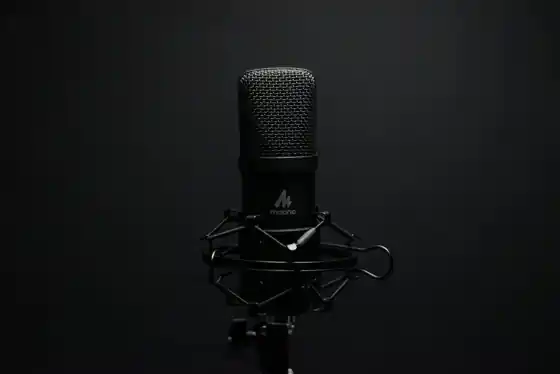
Bali has eight studios that record podcasts to genuine recording-studio standards — meaning a real preamp chain, multitrack capture, acoustic treatment, and a multitrack deliverable rather than a single bounced MP3. Verified hourly rates run Rp600k–Rp1.9M, with the audio-quality sweet spot sitting around Rp1.1M–Rp1.55M at Genesis, VoxPop, and Villo. The right one for you depends less on price than on mic count, room treatment, and whether you get the raw stems back. Most podcast bookings on Bali end up over-camera-ed and under-mic-ed.
What "recording studio" actually means for a Bali podcast
The phrase "recording studio" carries different meanings depending on who's listing it on Bali. Three meanings show up in Google results for the same search, and they aren't interchangeable.
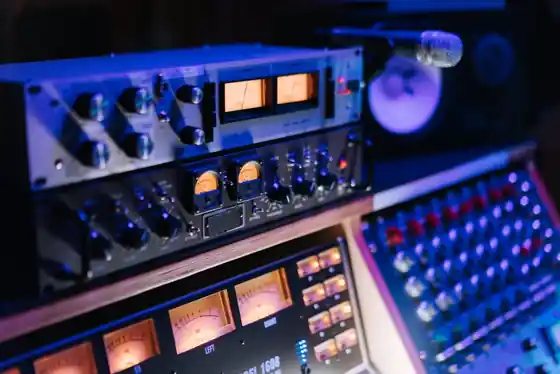
Music recording studio. Purpose-built room with bass trapping, an SSL or Neve-class console, full multitrack capture, often a live tracking room separate from the control room. Soma Sound Studios in Ubud is the only verified SSL 9000J on Bali; AMPS Music Studio in Denpasar is the highest-reviewed in this category at 315 GMaps reviews. Built for music. Booking one for an audio podcast is overkill — and the operators usually tell you so before they take the deposit.
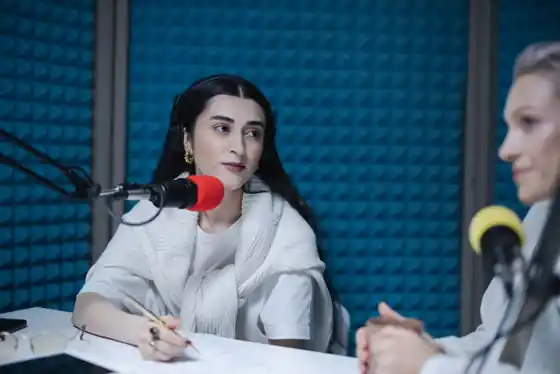
Podcast recording studio (the one this guide is about). Room treated for spoken word, two to four microphones on real preamps and an audio interface, multitrack capture into Pro Tools or Logic, treated walls but not the deep acoustic engineering of a music room. Villo Studio, Genesis Creative Centre, VoxPop, Hot Tea, and On Air Studio sit here. They record podcasts to broadcast-grade audio standards while shooting one to three cameras alongside.
Podcast room. A pleasant room with microphones on a stand, often capturing into a USB interface or an all-in-one device like the RØDECaster Pro II, with light acoustic treatment and a video kit prioritised over the audio chain. The marketing photos look identical to the previous tier; the difference shows up in the post-production. If you ask whether you'll get individual track stems and the answer is "we'll send you the final mix," you're booking a podcast room, not a recording studio.
The rest of this guide treats "podcast recording studio" as the second tier: real audio chain, multitrack capture, stems delivered. We name the eight Bali operators that genuinely meet that bar.
How much does a podcast recording studio cost in Bali?
Verified rates from operator pages and our April 2026 calls. Three honest tiers, all measured by what the audio chain actually delivers — not by the camera count on the marketing page.
Budget — Rp600k to Rp950k per session. Creators Studio Bali in Canggu sits at Rp600k for a 1-camera session; the audio side is typically a single condenser plus the room's house interface, captured to a stereo file. Honest fit for solo audio podcasts where you own the post-production chain. Genesis Creative Centre starts at Rp950k for 1-camera, with a more developed audio chain — separate condenser per host into a real preamp, multitrack capture available on request.
Mid-market — Rp1.0M to Rp1.55M per session. This is where most Bali podcasts that get released regularly actually record. VoxPop Podcast Studio in Pererenan does Rp745k for 1-camera and Rp1.095M for 2-camera, both with Shure SM7B-class microphones and discrete preamps. Villo Studio runs Rp1.25M / Rp1.55M / Rp1.65M across 1- to 3-camera setups, with multitrack delivery as standard. Genesis at Rp1.1M for 2-camera with the audio chain unlocked sits in the same neighbourhood. The mic chain quality here closes most of the gap to a dedicated music room.
Premium — Rp1.65M to Rp1.9M per session, plus the long-form tier above. Villo Studio's 3-camera at Rp1.65M includes telesufler, multitrack to a producer cut, and same-week post-production turnaround. ICON MEDIA in Kerobokan asks Rp1.9M for 3-camera with a brand-content production polish. HypeHunters in Denpasar sits in a separate league at Rp3.8M for 3-camera; the audio chain on the premium tier is genuinely broadcast-grade — large-diaphragm condensers, multiple preamp options, a treated isolation booth on request. Studio42 in Ubud at Rp3.5M for two hours operates on the same shelf.
An honest note on what these prices buy on the audio side specifically: the upgrade from Rp600k to Rp1.25M is a real jump (USB chain to discrete preamp + multitrack); the upgrade from Rp1.25M to Rp1.9M is a smaller jump on the mic chain itself and a larger jump on the operator, the room, and the post-production. Past Rp1.9M, you're paying for the operator's calendar and the room's reputation more than for the microphones in front of you.
What separates a recording studio from a podcast room
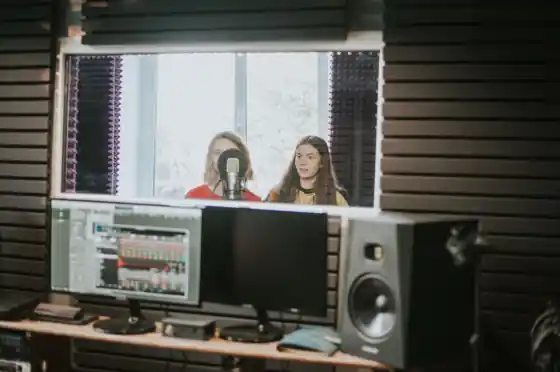
If the photos on Instagram look identical, what's the actual delta? Four variables, none of which most studio listings publish openly. Worth asking on the booking call.
Microphone count and class. A serious podcast recording studio runs one large-diaphragm condenser per host on a dedicated boom or shock-mount stand, plus a lavalier option for moving guests. The class matters: Shure SM7B, Rode NT1A, Neumann TLM-103, and Sennheiser MKH-416 are the four mic models that show up across the Bali premium tier. Below that, the chain bottlenecks before the room or the operator gets a chance to add value. The mistake on the booking call is counting cameras instead of asking how many independent microphone channels the room can record simultaneously.
Preamp and interface. Real recording studios run microphones into a discrete preamp (Universal Audio Apollo, Focusrite Clarett, RME Babyface) and capture into a DAW with multitrack. Podcast rooms often run the same microphones into the all-in-one RØDECaster Pro II — which is a good device but limits you to its built-in compressor and lacks the headroom of a dedicated preamp chain. The difference isn't visible on the marketing page; it's audible on the final episode if you listen for vocal warmth and dynamic range.
Acoustic treatment. A genuine recording studio has measured RT60 (the time a sound takes to decay) of 0.3-0.4 seconds — quiet enough for clean voice capture, lively enough not to sound like an isolation booth. A podcast room often has soft furniture and a few wall panels for visual coverage but no measured treatment; rain-season storms and scooter traffic bleed through more than the photos suggest. Bali's villa-conversion environment is the structural challenge: most spaces were not built as studios, so the treatment is retrofitted.
Multitrack delivery. This is the cleanest test for whether a room is a real recording studio. Ask the operator what file format you get back. If the answer is "a final MP3" or "the edited episode," you're booking a podcast room. If the answer is "individual stems per microphone, plus the cut, in WAV at 24/48," you're booking a recording studio. The difference matters when you want to remix the episode later, swap a sponsor read, or run the audio through a third-party post-production house.
The single most useful question to ask any Bali studio before you book: how many independent microphone channels does the room capture, and do I get the multitrack stems back? Most studios will answer honestly. The ones that dodge the question are usually podcast rooms wearing a recording studio's marketing.
Eight Bali podcast recording studios — by audio capability
Ranked by the recording-quality criteria above (mic chain + treatment + multitrack delivery), not by camera count or Instagram presence. Verified through operator pages and our April 2026 calls.
Villo Studio (North Kuta) — multilingual operator, full multitrack chain. Rp1.25M / Rp1.55M / Rp1.65M across 1-, 2-, and 3-camera setups. Four discrete microphone channels available; large-diaphragm condensers on dedicated boom arms; Universal Audio preamp chain; multitrack delivery as standard. 4.9★ across 128 GMaps reviews, 50 of them in Russian, with the team — Dam, Damir, Nara, Anton — named directly in over 12 reviews. Operator name recall in reviews is the strongest single signal we track for recording-quality consistency; clients who name the engineer record there again. Talking Head, Podcast, and Webinar formats make up roughly 80% of bookings.
Genesis Creative Centre (North Kuta) — heavy-volume operator with a real audio chain. Rp950k / Rp1.1M / Rp1.25M. The most-reviewed studio in our catalogue at 313 GMaps reviews. Audio side: separate condenser per host into a discrete preamp, multitrack capture available on request (ask explicitly — the default may bounce to stereo). Honest caveat: Genesis responds to less than a third of its GMaps reviews — volume doesn't equal engineering attentiveness on individual sessions.
VoxPop Podcast Studio (Pererenan) — small-shop reputation, transparent chain. Rp745k / Rp1.095M / Rp1.495M. Shure SM7B-class microphones, discrete preamp chain, multitrack as default. 4.9★ across 30 reviews — small sample, but 91%+ owner-response rate, the highest in our caller logs. Pricing transparency above the cluster average.
ICON MEDIA (Kerobokan) — brand-content production polish, premium audio chain. Rp1.9M for 3-camera. 5.0★ across 37 reviews. Audio side polished for editorial podcasts where production value carries the brief. Treated isolation booth on request.
Hot Tea Podcast Studio (Uluwatu) — south-side, single-cluster operator. Rp1.7M for 1-camera. 4.9★ across 45 reviews. The only podcast recording studio in our catalogue south of the airport — book it only if you're already south, the commute kills the booking otherwise.
On Air Studio (Tibubeneng) — 4K-focused, video-led podcast room. Rp1.4M for 3-camera. 4.8★ across 18 reviews. Audio chain is competent but tuned for video-distribution podcasts rather than audio-first work. Multitrack on request, default is the cut.
HypeHunters Production (Denpasar) — premium, broadcast-grade. Rp3.8M for 3-camera. 5.0★ across 22 reviews. About 29% of clients are Russian-speaking — structurally relevant if your podcast targets CIS audiences. Audio chain is the most engineered in the Bali catalogue; the price reflects the operator's calendar and production team alongside the room itself.
Creators Studio Bali (North Kuta) — budget audio entry. Rp600k for 1-camera, audio side typically a single condenser on the room's house interface. 5.0★ across 26 reviews. The right fit for solo audio podcasters who own their own post-production chain and want a quiet, treated-enough room for under Rp1M. Not the right fit if you need stems for a multi-host episode.
A handful of smaller operators (Sunny Mantra in Canggu, 641 Studio) take Instagram DMs rather than running booking calendars and don't appear in our caller logs at depth. Worth a call for a specific niche brief; not the right default for a first-time podcast recording booking on Bali.
Recording deliverables — raw, edited, mastered, and what each costs
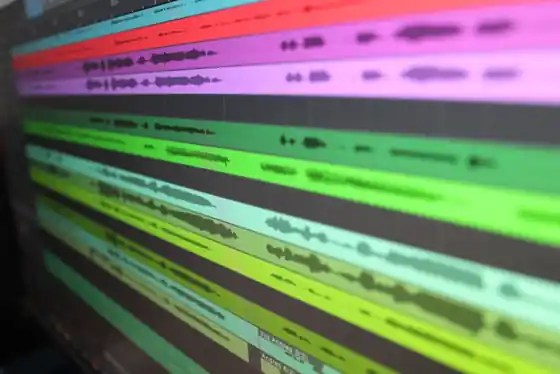
Recording capture is one product. Editing, mixing, and mastering are three separate products. Most Bali studios bundle them in different combinations; some bundle nothing and quote separately. Knowing the four deliverable tiers before you book saves a long back-and-forth on the session day.
Raw multitrack. Individual stems per microphone in WAV at 24-bit/48kHz, plus the synced video files if it's a video podcast. This is what you take if you have your own editor. Villo, VoxPop, Genesis (on request), and HypeHunters all deliver this by default. The transfer is usually a Google Drive or Dropbox link within 24-48 hours after the session.
Editing only. Cuts, silence removal, basic sponsor read insertion. Typical price on Bali: Rp1.5M-Rp2.5M for a 45-60 minute episode, depending on operator. Villo and Genesis offer editing as an add-on at this price band. Useful when you can write your own intro and outro but don't want to sit through the silence-cutting yourself.
Mixing. EQ, compression, level balancing, ducking music against voice, removing room noise. Typical price: Rp2M-Rp3.5M per episode on top of the editing fee. This is where the multitrack stems matter — without them, the mix is a polish job rather than a real rebuild. Villo's video editing service runs at 7.1% of total revenue at the studio, suggesting most clients take the full chain.
Mastering. Final level normalisation to broadcast standards (-16 LUFS for Spotify, -14 LUFS for YouTube), inter-sample peak limiting, loudness consistency across episodes. Typical price: Rp500k-Rp1M per episode as a standalone service. Most Bali podcast operators bundle this into the mixing price rather than charging separately. Ask for the target LUFS specifically — it's the test that separates a real master from a louder mix.
The honest pricing maths: a fully-produced 60-minute podcast episode at Bali rates lands between Rp4M and Rp7M end-to-end (record + edit + mix + master), depending on operator. That's higher than people expect when they walk into the booking call thinking about hourly studio rates alone. Buying the studio time without the post-production is a smaller cost; finishing the episode is the rest of the project. Plan for the full chain when you budget.
How to book a recording-grade podcast session — step by step
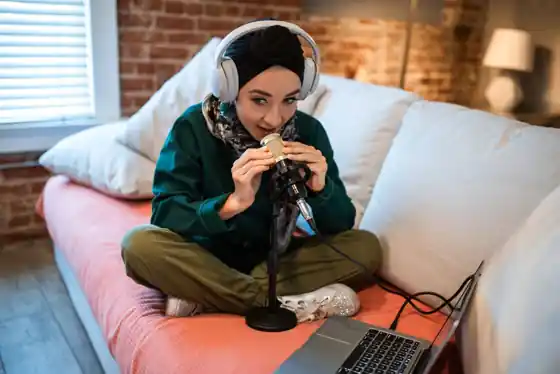
1. Decide whether you actually need a recording studio. A USB Shure MV7+ in a treated bedroom outproduces most Bali podcast rooms for solo audio. Book a recording studio when you have two or more hosts, need multitrack stems, or want video alongside. Otherwise the studio fee buys you nothing the bedroom doesn't.
2. Ask three audio-chain questions before the camera count. How many independent microphone channels does the room record simultaneously? What microphone models are on the floor? Do I get the multitrack stems back as WAV at 24/48? Operators who answer these questions cleanly are recording studios. Operators who dodge them or default to camera-count answers are podcast rooms in recording-studio clothing.
3. Send three candidate dates and a clear format. "Two-host audio podcast, 60 minutes, multitrack stems delivered" gets a clean quote. "I need a podcast studio" gets a 24-hour back-and-forth. Premium operators (Villo, Genesis, HypeHunters) book 5-7 days out; mid-tier 2-3 days; budget tier 24-48 hours.
4. Confirm the deliverable in writing. The booking confirmation should list: number of microphone channels, multitrack format (WAV 24/48), delivery timeframe, what editing/mixing/mastering is included or separate. The single most common Bali recording-studio confusion is "is post-production in the price?" — solve it in writing before the deposit lands.
5. Pay the deposit; lock the slot. Bali standard is Rp500k-Rp1M, typically 30-50% of session value. Xendit international card and BNI local transfer are both standard at the main operators. The slot only locks once the deposit arrives — "I'll book it" doesn't actually book anything.
6. Brief the operator 48 hours before the session. Format, host count, run time, episode structure (sponsor reads, music beds, segment changes), and whether you need a click track in the host monitors. Twenty minutes of session setup confusion is the most common recoverable loss; the brief avoids it.
Common podcast recording mistakes — and what they cost
Counting cameras instead of microphones. This is the single most expensive booking mistake on Bali. A three-camera 4K setup with one cardioid microphone records a video podcast that sounds worse than a two-microphone audio session. We pulled the operator name-recall data from Villo's review base — 12+ direct mentions of the engineer in 150 reviews — because clients who hear good audio remember who recorded it, not which lens was used. If you're booking by camera count, you're optimising the wrong axis.
Skipping the multitrack stems question. Asking for cameras and prices, then discovering on session day that the room only delivers a stereo bounce, costs you the entire mix-rebuild possibility for that episode. Cheaper studios sometimes default to the bounced final cut rather than stems because that's how their post-production pipeline is built. Confirm WAV stems in writing before the deposit lands.
Booking against airport-direction traffic. Jl. Sunset Road and the airport corridor run 45+ minutes for a 12km transit after 4pm on weekdays. Booking a 5pm session at HypeHunters in Denpasar from a Canggu villa means leaving at 3:45pm. We've heard from operators about clients who showed up 30 minutes late and lost the session.
Treating Genesis and VoxPop as interchangeable. Both are mid-tier audio chains, both 4.8-4.9★, both in the Canggu cluster. The difference is owner-response rate (Genesis 33%, VoxPop 91%+) and the resulting service feel on multi-session relationships. For a one-off booking, this rarely matters. For a weekly podcast where you'll book 20+ times, it shapes the working relationship more than the gear difference does.
Underbudgeting post-production. The studio hourly rate is a fraction of the full episode cost. A Rp1.55M Villo recording session that turns into a Rp2.5M edit and a Rp2.5M mix lands the finished episode at Rp6.55M. Buying the studio time without budgeting the post-production chain is the most common reason podcast pilots stall after the first three episodes — the recording is fine; the back-of-house cost catches the producer by surprise.
When NOT to book a podcast recording studio in Bali
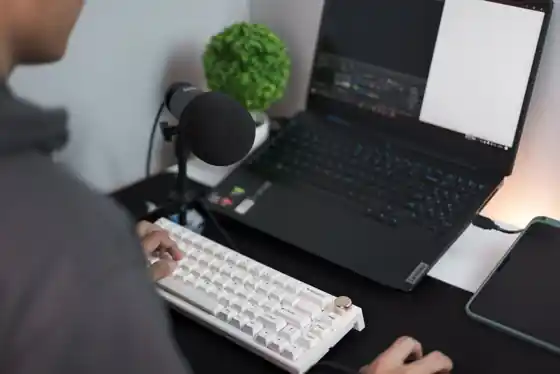
Booking a recording studio is the right answer for multi-host podcasts, sponsor-driven shows, and any format where the audio needs to hold up next to network-grade production. It's the wrong answer in five specific cases, and we'd rather you book the right setup than the most expensive one.
If you're recording solo audio only and your room is reasonably treated, a Shure MV7+ or Rode NT-USB Mini into a laptop will outproduce the bottom half of Bali's podcast recording studios for a single hour of work. The studio fee buys you a marginally better mic chain and zero room acoustics that your bedroom doesn't already provide. Spend the Rp1M somewhere else.
If you're recording with a remote guest, the studio doesn't help — your audio is fine on the local side, but the guest's audio still routes through Zoom or Riverside. Riverside.fm and SquadCast handle remote multitrack better than any Bali studio recording you locally and pulling in the guest over a video call. Book the local studio only if both hosts are physically present.
If your podcast is music-led — band interviews with live performance segments, music production deep-dives where you record a song mid-episode — book Ubud's music recording studios, specifically Soma Sound Studios for the SSL 9000J console. No Canggu podcast recording studio runs the multi-channel chain needed for a live band tracking insert. The mismatch shows up in the final audio.
If you need transparent published pricing for a one-shot recording and you've never booked a Bali studio before, the self-photo and creator-studio cluster in Denpasar publishes rates more openly than parts of the podcast recording cluster. Some podcast operators still quote on inquiry — fine for repeat clients, friction for first-time bookings.
If you only need a video podcast clip for Instagram or YouTube Shorts, a phone on a tripod with one Rode Wireless Pro lavalier outproduces a Rp1.55M studio session at the format level. The studio gives you room treatment and multitrack stems you'll never use for a 30-second clip. The format mismatches the deliverable.
We list these mismatches because Near Me's job is to send people to the recording setup that actually fits, not to push the densest cluster as a default. The right answer for a solo audio podcast isn't a Bali recording studio — and that's an honest pointer rather than a missed booking. Our broader podcast studio rental guide covers operators across all use cases; the Canggu podcast cluster guide covers the same district's video-podcast side. The music recording guide handles music-led briefs.
Frequently asked
What's the difference between a podcast recording studio and a podcast room in Bali?+
A real recording studio captures each microphone to an independent track at 24-bit/48kHz, runs the signal through a discrete preamp chain (Universal Audio, Focusrite, RME), and delivers multitrack stems plus the video files. A podcast room captures into an all-in-one device like the RØDECaster Pro II, often bounces to a stereo mix on the way out, and delivers the final cut rather than stems. The marketing photos look identical; the difference is audible in the final episode if you listen for vocal warmth and dynamic range. Ask explicitly about multitrack stems on the booking call.
Do Bali podcast recording studios deliver multitrack stems?+
Villo Studio, VoxPop, and HypeHunters deliver multitrack WAV stems as standard. Genesis Creative Centre delivers stems on request — the default may bounce to stereo. Creators Studio Bali and the budget tier typically don't deliver stems; the audio side is built for solo capture rather than multi-track production. Always confirm in writing before the deposit lands. Multitrack stems matter when you want to remix the episode, swap a sponsor read, or run audio through a third-party post-production house.
How many microphones do I need for a 3-host podcast in Bali?+
Three large-diaphragm condensers on dedicated boom arms, plus an optional fourth lavalier channel for moving guests or B-roll capture. Villo, Genesis, VoxPop, and HypeHunters all support four independent microphone channels by default. Creators Studio Bali and On Air Studio support two-three channels reliably. For four-plus hosts, confirm channel count in writing — the marketing photos often show more microphones than the audio chain can record simultaneously.
Can I record voiceover-grade audio at a Bali podcast studio?+
For broadcast-grade narration where every breath is audible, Mercury Music Studio in South Kuta (5.0★, 349 reviews, the most-reviewed music studio on the island) or Soma Sound Studios in Ubud (SSL 9000J console) deliver the room treatment that Bali's villa-converted podcast rooms don't match. Premium podcast recording studios (Villo, Genesis, VoxPop) are close enough for most spoken-word work, but rain-season storms and scooter traffic bleed through more than a purpose-built isolation booth. Match the room to the deliverable.
What does a fully-produced podcast episode cost on Bali end-to-end?+
Recording (Rp1.25M-Rp1.55M for 2-host session) plus editing (Rp1.5M-Rp2.5M) plus mixing (Rp2M-Rp3.5M) plus mastering (typically bundled into mixing) lands a 60-minute fully-produced episode at Rp4M-Rp7M end-to-end. The studio hourly rate is the smaller piece — most of the cost is back-of-house post-production. Buying recording time without budgeting post-production is the most common reason Bali podcast pilots stall after three episodes.
Is acoustic treatment important for podcast recording in Bali?+
Yes, but probably less than people think. A treated room with RT60 of 0.3-0.4 seconds gives you broadcast-quality voice capture. Most Bali podcast recording studios meet this bar — the villa-conversion environment is the structural challenge, but premium operators (Villo, Genesis, VoxPop) invest in genuine acoustic treatment. The room matters more than acoustic perfection: ask whether external noise (street traffic, rain on metal roofing, air-conditioning units) bleeds through during peak hours rather than fixating on isolation specs.
Can I record a podcast with a remote guest from a Bali studio?+
The local audio side will be fine — your studio mic chain captures your voice cleanly. The guest's audio still routes through Zoom, Riverside.fm, or SquadCast, which means the remote audio quality depends on their setup, not yours. Riverside and SquadCast handle remote multitrack recording better than capturing the Zoom call locally — both record the guest's audio on their own device and upload high-quality stems to the cloud. If both hosts are remote, skip the studio entirely and use Riverside or SquadCast direct.
What's the cheapest podcast recording studio in Bali that delivers stems?+
VoxPop Podcast Studio in Pererenan at Rp745k for 1-camera with multitrack stems delivered as standard. Genesis Creative Centre at Rp950k for 1-camera with stems on request (ask explicitly). Below those, Creators Studio Bali at Rp600k is studio-only audio capture without multitrack — fine for solo audio podcasts but not for multi-host stem delivery. For first-time bookings where the audio chain matters and the budget is below Rp1M per session, VoxPop is the practical default.
Keyword cluster
About the author
Philippe Durand· Production Specialist
Independent producer based in Canggu since 2019. Spent the last six years inside Bali's video and podcast studios — first as a hired director, now reviewing them for Near Me. Full profile →
Ready to find a studio?
Browse our full catalog of 17+ Bali studios, or jump to the podcast category.